
Marketing has always been the backbone of business growth. From newspaper ads to social media campaigns, the way businesses reach customers has evolved significantly. Today, companies must choose between traditional marketing and digital marketing—or find the right balance between bothIn this detailed blog, we’ll explore what traditional and digital marketing are, their differences, advantages, disadvantages, and which one is better for modern businesses.
What is Traditional Marketing?

Traditional marketing refers to offline promotional methods that have been used for decades to reach customers and build brand awareness. In the discussion of traditional marketing vs digital marketing, traditional marketing includes common channels such as television advertisements, radio ads, newspaper and magazine ads, billboards and posters, flyers and brochures, and direct mail. These methods focus on reaching a broad audience through physical or broadcast media rather than online platforms. For example, when a clothing brand places an advertisement in a newspaper or runs a TV commercial, it is using traditional marketing to attract potential customers and increase visibility.
What is Digital Marketing?
Digital marketing is the promotion of products and services using online platforms and digital technologies, playing a major role in the discussion of traditional marketing vs digital marketing. It includes key strategies such as Search Engine Optimization (SEO), Social Media Marketing (SMM), Search Engine Marketing (SEM), content marketing, email marketing, and influencer marketing, all designed to reach and engage audiences effectively online
. For example, when a business promotes its products on Instagram or improves its website ranking on Google, it is using digital marketing to attract and convert customers. In the comparison of traditional marketing vs digital marketing, digital marketing stands out for its ability to connect with a global audience, deliver targeted campaigns, and provide measurable results in real time.
Traditional Marketing vs Digital Marketing (Comparison Table)
Digital marketing is the promotion of products and services through online platforms and modern digital technologies, making it a key component in the debate of traditional marketing vs digital marketing. It includes popular strategies such as Search Engine Optimization (SEO), Social Media Marketing (SMM), Search Engine Marketing (SEM), content marketing, email marketing, and influencer marketing, all of which help businesses connect with their audience in a more targeted and measurable way
. For example, a business promoting its products on Instagram or ranking its website on Google is effectively using digital marketing to reach potential customers. When comparing traditional marketing vs digital marketing, digital marketing stands out for its global reach, cost-effectiveness, precise audience targeting, and real-time interaction, whereas traditional marketing relies on offline channels like TV and print, offers limited targeting, and is harder to measure and modify. Overall, digital marketing provides faster results, better flexibility, and detailed analytics, making it a powerful choice for modern businesses.
Advantages of Traditional Marketing
Digital marketing is the promotion of products and services using online platforms and digital technologies, playing a major role in the discussion of traditional marketing vs digital marketing. It includes key strategies such as Search Engine Optimization (SEO), Social Media Marketing (SMM), Search Engine Marketing (SEM), content marketing, email marketing, and influencer marketing, all designed to reach and engage audiences effectively online. For example, when a business promotes its products on Instagram or improves its website ranking on Google, it is using digital marketing to attract and convert customers.
In the comparison of traditional marketing vs digital marketing**, digital marketing stands out for its ability to connect with a global audience, deliver targeted campaigns, and provide measurable results in real time.
Disadvantages of Digital Marketing
When analyzing traditional marketing vs digital marketing, both approaches come with their own advantages and limitations that businesses must consider. Traditional marketing helps build strong brand trust, especially among older audiences who tend to rely more on TV ads and newspapers, and it is highly effective for reaching a wide local audience within a specific area. It also offers a tangible presence through physical materials like brochures, which can leave a lasting impression, and often faces less competition compared to crowded digital platforms. However, traditional marketing has several drawbacks, including high costs for TV and print advertising, lack of accurate tracking, limited customer engagement, and a slower process when launching or updating campaigns.
On the other hand, digital marketing stands out in the traditional marketing vs digital marketing comparison due to its global reach, cost-effectiveness, and ability to target specific audiences based on age, location, and interests. It also provides measurable results through tools like Google Analytics and social media insights, while enabling real-time interaction with customers through comments, chats, and emails, making it a more flexible and data-driven approach for modern businesses.
Which is Better for Businesses
When it comes to traditional marketing vs digital marketing, the right choice ultimately depends on your business goals and target audience. You should choose traditional marketing if your audience is mostly offline, if your focus is on building strong local brand awareness, or if you are targeting older demographics who are more likely to trust TV, print, and other offline channels. On the other hand, digital marketing is the better option if you want to reach a global audience, need measurable results to track performance, are working with a limited budget, or aim for fast business growth. Understanding the strengths of both approaches in the traditional marketing vs digital marketing debate helps businesses make smarter, goal-oriented marketing decisions.
Integrated Marketing (Best Strategy)
In the debate of traditional marketing vs digital marketing, modern businesses are increasingly finding success by combining both strategies rather than choosing just one. A balanced approach allows companies to maximize their reach and impact—for example, using TV advertisements to build strong brand awareness while leveraging SEO and social media platforms to drive engagement and conversions. This integrated method takes advantage of the strengths of both offline and online channels, creating a powerful and effective marketing system that supports long-term business growth.
Why Digital Marketing is the Future
In the discussion of traditional marketing vs digital marketing, the rapid rise of digital marketing is driven by key factors such as the increasing number of internet users, the growth of e-commerce, a mobile-first audience, and advancements in AI and automation. These trends have made digital marketing an essential strategy for modern businesses. Digital marketing has completely transformed how companies interact with their target market, offering advantages like speed, precision, flexibility, and measurable growth. Unlike traditional methods, it allows businesses to adapt quickly, reach the right audience, and track performance effectively, making it a powerful and indispensable part of today’s marketing landscape.
Advantages of Digital Marketing (Detailed Guide)
In the comparison of traditional marketing vs digital marketing, digital marketing stands out as a powerful and essential strategy due to its wide range of advantages. It enables global reach, allowing businesses to connect with customers worldwide without location barriers—even a small business in Kerala can sell products internationally. One of its biggest strengths is precise audience targeting based on age, location, interests, and behavior, ensuring higher conversion rates.
Digital marketing is also cost-effective, making it accessible for startups and freelancers, while offering measurable results such as website traffic, clicks, and engagement for data-driven decisions. Its ability to deliver instant results, quick campaign execution, and real-time adjustments gives businesses a competitive edge. Additionally, it enhances customer engagement through two-way communication, supports mobile accessibility, and allows flexibility with continuous optimization and A/B testing.
Personalization further improves customer experience and loyalty, while strong SEO strategies help achieve long-term organic growth and visibility. With multiple marketing channels like social media, search engines, email, and video platforms, businesses can build strong brand awareness and gain a competitive advantage. Overall, in the debate of traditional marketing vs digital marketing, digital marketing proves to be more dynamic, scalable, and result-oriented for modern business success.
Disadvantages of Digital Marketing (Detailed Guide)
In the comparison of traditional marketing vs digital marketing it’s important to recognize that while digital marketing offers many advantages, it also comes with several challenges that businesses must manage carefully. One major issue is high competition, as digital platforms are crowded with thousands of businesses promoting similar products, making it difficult to stand out without strong strategy and creativity.
Digital marketing also requires specialized skills in areas like SEO, content creation, advertising, and analytics, along with continuous learning to avoid costly mistakes. It can be time-consuming, as strategies like SEO and content marketing take months to deliver results, and building a loyal audience requires patience. Additionally, it heavily depends on technology, internet access, and third-party platforms, which can be affected by technical issues or frequent algorithm changes
. Hidden costs such as paid ads, tools, and software can add up over time, while negative feedback and public reviews can quickly impact brand reputation. Privacy concerns, data security risks, ad fatigue, and dependence on paid ads further complicate the landscape. Moreover, information overload, rapidly changing trends, and the need for continuous monitoring and optimization make digital marketing a demanding process. Therefore, in the debate of traditional marketing vs digital marketing, businesses must balance these challenges with the benefits to create effective and sustainable marketing strategies.
Advantages of Traditional Marketing (Detailed Guide)
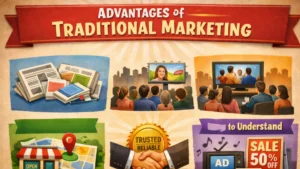
In the discussion of traditional marketing vs digital marketing, traditional marketing continues to be a powerful and reliable approach, especially for building brand trust, credibility, and strong local presence. Platforms like TV, newspapers, and radio are widely trusted and help create a professional image, particularly among older audiences who rely more on traditional media. It is highly effective for targeting local customers, making it ideal for small businesses such as shops, restaurants, and service providers. Traditional marketing is also easy to understand, with simple and direct messaging that appeals to all age groups. Its ability to deliver wide mass reach through channels like television, radio, newspapers, and billboards makes it perfect for large-scale brand awareness campaigns.
Additionally, physical materials like brochures, flyers, and posters provide a tangible presence that strengthens brand recall and leaves a lasting impression. With fewer distractions and less competition compared to digital platforms, audiences are more likely to notice and engage with the message. Traditional marketing also allows for strong creative impact through emotional TV ads and visually appealing print campaigns, helping build long-term brand recognition through repeated exposure. High visibility, the ability to work without internet access, and effectiveness in reaching rural or offline audiences further highlight its importance. Therefore, in the comparison of traditional marketing vs digital marketing, traditional marketing remains a valuable strategy for businesses aiming to establish trust, visibility, and consistent brand awareness.
Disadvantages of Traditional Marketing (Detailed Guide)
In the comparison of **traditional marketing vs digital marketing**, it is important to understand that while traditional marketing has been effective for decades, it also comes with several limitations in today’s fast-paced digital world. One of the biggest drawbacks is its high cost, as TV commercials, print ads, and billboards require significant investment, making them less suitable for small businesses. It is also difficult to measure results, with no accurate way to track performance, ROI, or audience engagement, forcing businesses to rely on assumptions rather than data.
Traditional marketing offers limited audience targeting, often reaching a broad and sometimes uninterested audience, which can reduce conversion rates. Additionally, it is time-consuming, with delays in planning, production, and launch, and lacks flexibility since ads cannot be easily modified once published.
The one-way communication model limits customer interaction and engagement, making it harder to build strong relationships. Its reach is often restricted to local or regional audiences, and expanding globally can be costly. Moreover, the absence of real-time analytics slows down decision-making and campaign optimization. Traditional marketing materials also tend to have a short lifespan, as newspapers and flyers are quickly discarded, and they can negatively impact the environment due to paper usage. With less personalization, lower engagement, and a higher risk of wasted investment, these challenges highlight why businesses carefully evaluate **traditional marketing vs digital marketing** when choosing the most effective strategy.
Final Conclusion
In the discussion of traditional marketing vs digital marketing, both approaches play a crucial role in driving overall business growth when used strategically. Traditional marketing helps build strong trust and local brand awareness through familiar and credible channels, while digital marketing focuses on driving growth, increasing engagement, and delivering measurable results through data-driven strategies. Rather than choosing one over the other, the most effective approach is to combine both methods to maximize impact and reach a wider audience. Ultimately, in the debate of traditional marketing vs digital marketing, the key insight is clear: traditional marketing builds presence, but digital marketing builds performance, and together they create a powerful and balanced marketing strategy.
Author :RAJEENA ANVAR