
In today’s fast-evolving digital landscape, businesses must adapt their online strategies to remain visible and competitive, making SEO vs AEO a crucial topic to understand. For years, Search Engine Optimization (SEO) has been the foundation of digital marketing, helping websites rank higher on search engines and attract organic traffic. However, with the rise of voice search, AI assistants, and conversational queries, a new approach has emerged, shifting the focus from just ranking on search engines to directly answering user questions. This evolution highlights the growing importance of SEO vs AEO, where businesses must balance traditional optimization techniques with answer-focused strategies to stay ahead in the digital space.
Answer Engine Optimization (AEO).
While SEO focuses on improving visibility in search engine results pages (SERPs), AEO is centered on delivering direct, concise answers to users through AI-driven platforms like voice assistants and smart search features. Understanding the difference between SEO and AEO is essential for businesses aiming to succeed in the modern digital ecosystem.
This section explores both concepts in depth, highlighting their importance, differences, strategies, and how they work together to create a powerful online presence.
What is SEO?
SEO vs AEO is an important topic in modern digital marketing, and understanding SEO is the first step. SEO (Search Engine Optimization) is the process of improving a website to rank higher on search engines like Google and attract more organic (free) traffic. It works by optimizing content quality, using the right keywords that people search for, improving website structure, increasing speed and mobile-friendliness, and building backlinks from other trusted websites.
SEO includes three main types: On-Page SEO (optimizing content, titles, and keywords), Off-Page SEO (building backlinks and online authority), and Technical SEO (improving website performance and usability). It is important because it increases visibility, builds trust, brings more potential customers, and is cost-effective compared to paid advertising. In the context of SEO vs AEO, SEO helps your business appear in front of the right audience at the right time, leading to more traffic, better engagement, and higher growth.
When discussing seo vs aeo, understanding the key components of SEO is essential for building a strong online presence. SEO is mainly divided into on-page and off-page optimization. On-page SEO involves optimizing elements within your website, such as using relevant keywords in titles and headings, writing effective meta descriptions, improving content quality and readability, and ensuring proper image optimization.
Off-page SEO, on the other hand, focuses on external factors that influence your website’s authority and ranking, including building high-quality backlinks from authoritative websites and gaining social signals from platforms like social media. In the comparison of seo vs aeo, mastering these SEO components helps improve visibility on search engines and lays the foundation for better performance in both search and answer-based optimization strategies.

Key Features of SEO (Search Engine Optimization)
In the discussion of SEO vs AEO, understanding the core features of SEO is essential for building a strong digital presence. Search Engine Optimization (SEO) is a powerful strategy that improves a website’s visibility, traffic, and overall performance by focusing on multiple key elements. It begins with keyword optimization, where the right short-tail and long-tail keywords help target the correct audience and improve search relevance.
On-page optimization enhances website elements such as title tags, meta descriptions, headings, URL structure, image alt text, and internal linking, while high-quality content ensures better rankings, user engagement, and reduced bounce rates. Technical SEO plays a crucial role by improving website speed, mobile-friendliness, security (HTTPS), and proper indexing through sitemaps. Off-page SEO builds authority through backlinks, social signals, and guest blogging, while user experience (UX) ensures easy navigation, clean design, and responsiveness.
SEO also drives organic traffic, offering a cost-effective and long-term growth strategy with consistent visitor increases. It improves search engine rankings, boosts visibility, and increases conversion chances, while local SEO helps target nearby customers through optimized listings and location-based keywords. Additionally, analytics and performance tracking allow businesses to monitor traffic, keyword rankings, and user behavior for continuous improvement. In the comparison of SEO vs AEO, these SEO features provide a strong foundation for long-term success, competitive advantage, and sustainable online growth.
What is AEO (Answer Engine Optimization)?

In the discussion of SEO vs AEO, Answer Engine Optimization (AEO) represents a modern strategy that focuses on delivering direct and precise answers to user queries rather than just improving search rankings. AEO ensures that content is selected by AI systems, voice assistants, and search engines as the best possible answer, making it highly relevant for voice search results, featured snippets, AI chat assistants, and smart devices.
It emphasizes understanding user intent, using structured content that machines can easily interpret, and adopting conversational language that mirrors how people naturally speak. Additionally, AEO prioritizes quick and clear responses instead of lengthy explanations, making it an essential approach in the evolving landscape of SEO vs AEO where instant and accurate information is key.
SEO vs AEO: Key Difference
-
SEO vs AEO: Key Difference
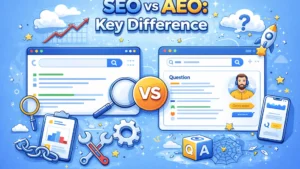
In the comparison of SEO vs AEO, both strategies differ in purpose, format, and user experience. SEO focuses on improving website ranking and visibility by optimizing long-form, keyword-rich content for text-based searches, where users browse a list of links and click to explore websites. In contrast, AEO is designed to provide direct and precise answers to user queries, especially for voice and conversational searches, using short and structured content. Instead of showing multiple links, AEO delivers instant results through featured snippets, voice responses, or AI-generated answers, reducing the need for users to click further. This highlights how SEO vs AEO represents a shift from search-based discovery to answer-based interaction in the digital landscape.
The Evolution from SEO to AEO
In the evolving landscape of SEO vs AEO, digital behavior is changing rapidly as users move from typing short keywords like “best restaurant Kerala” to asking full, conversational questions such as “What is the best restaurant near me in Kerala?” This shift is driven by the rise of voice assistants, AI-powered search engines, increased mobile usage, and the growing demand for faster, instant information. As a result, businesses can no longer rely only on traditional SEO techniques and must embrace AEO strategies to provide direct, accurate answers and stay competitive in the modern digital environment.
Why SEO is Still Important

In the comparison of SEO vs AEO, it’s important to understand that despite the growing importance of AEO, SEO remains a fundamental part of any digital strategy. SEO continues to drive the majority of organic traffic, build strong website authority, support long-term growth, and enhance overall brand visibility. It acts as the foundation of your online presence, ensuring that your website is discoverable and credible in the eyes of search engines. Without a solid SEO base, your content may not even be considered for AEO results, making SEO an essential starting point in the evolving landscape of SEO vs AEO.
Challenges in SEO and AEO
Challenges in SEO and AEO
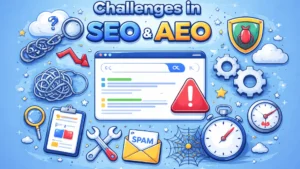
In the discussion of SEO vs AEO, both strategies come with their own challenges that businesses must navigate to succeed. SEO faces issues like high competition, constant algorithm updates, and time-consuming results, while AEO presents challenges such as limited control over how answers are displayed, the need for highly precise content, and dependence on AI systems. Understanding these challenges helps businesses create more effective and balanced strategies. Looking ahead, the future of digital marketing will be shaped by increased AI integration, the growth of voice search, more personalized search results, and smarter search engines. In this evolving landscape of SEO vs AEO, businesses that adapt to both approaches will be better positioned to stay competitive and achieve long-term success.
Benefits of Combining SEO and AEO
In the comparison of SEO vs AEO, combining both strategies offers powerful advantages that can significantly boost your digital presence. When used together, they increase visibility across multiple platforms, improve overall user experience, and drive higher engagement rates by meeting both search and answer-based needs. This integrated approach also leads to better conversion rates and helps build stronger brand authority over time. By leveraging the strengths of both methods, businesses can ensure they reach users at every stage of their search journey, making SEO vs AEO a complete and future-ready marketing strategy.
Advantages and Disadvantages of SEO vs AEO
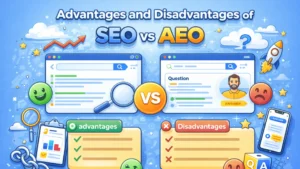
Advantages of SEO (Search Engine Optimization)
SEO remains one of the most powerful digital marketing strategies because it helps businesses build a strong and lasting online presence on platforms like Google. One major advantage is long-term sustainability—once a website ranks well, it can continue to generate traffic without ongoing ad spend. SEO also enhances brand credibility, as users trust websites that appear at the top of search results. Another key benefit is high ROI (Return on Investment), since organic traffic is free and highly targeted. Additionally, SEO supports content marketing, allowing businesses to educate, inform, and engage their audience while improving visibility. It also enables scalability, meaning businesses can expand their reach across multiple keywords, locations, and services over time.
Disadvantages of SEO
While SEO is powerful, it is not without challenges. One major drawback is the time delay in results, as it can take months to achieve top rankings. SEO is also highly competitive, especially in industries where many businesses target the same keywords. Another issue is algorithm dependency, as search engines frequently update their ranking systems, which can cause sudden drops in visibility. SEO also requires continuous effort, including content updates, technical improvements, and link building. Furthermore, measuring exact ROI can sometimes be complex, as multiple factors influence performance.
Advantages of AEO (Answer Engine Optimization)
AEO is designed for the modern user who expects quick and accurate answers. One of its biggest advantages is instant visibility, as content can appear directly in featured snippets or voice assistant responses. This leads to improved user satisfaction, since people get answers without needing to search multiple pages. AEO also enhances brand authority, as being selected as the top answer signals expertise and trustworthiness. Another benefit is voice search optimization, which is rapidly growing due to smartphones and smart devices. AEO also supports future-ready marketing, helping businesses stay aligned with AI-driven search trends and evolving user behavior.
Disadvantages of AEO
Despite its advantages, AEO presents several challenges. A major limitation is reduced website traffic, as users often get answers directly without clicking through to the site. There is also limited control over content display, since AI platforms decide how and when to show answers. AEO requires highly structured and precise content, which can be difficult to create consistently. Another issue is dependence on third-party platforms, meaning businesses rely on AI systems for visibility. Additionally, tracking performance and ROI in AEO is more complex compared to traditional SEO metrics.
When to Use SEO vs AEO
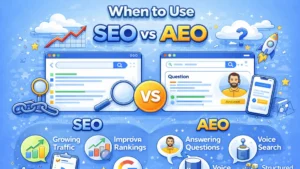
In the comparison of SEO vs AEO, choosing the right strategy depends on your goals, but the most effective approach is to use both together. SEO is ideal when you want to build long-term traffic, target competitive keywords, and encourage users to explore your website in depth. On the other hand, AEO is best when your goal is to answer specific questions, target voice search users, and gain quick visibility and authority through direct answers.
Rather than choosing one over the other, a balanced strategy works best—use SEO to attract users and bring them to your platform, and use AEO to provide instant, precise answers that satisfy their needs. By combining both approaches in the SEO vs AEO strategy, businesses can dominate both search results and answer-based platforms for maximum impact.
Conclusion
In the discussion of SEO vs AEO, both strategies represent essential pillars of modern digital marketing. While SEO focuses on improving website rankings, increasing visibility, and driving consistent traffic, AEO ensures that users receive quick and accurate answers to their queries through AI-driven and voice-based platforms. In today’s competitive online environment, relying only on SEO is no longer enough, as changing user behavior and advancing technology demand faster and more precise responses.
By combining both approaches, businesses can build a powerful digital presence that not only attracts visitors but also delivers instant value. Ultimately, the key to success in SEO vs AEO lies in maintaining the right balance—using SEO for visibility and long-term growth, and AEO for relevance and immediate user satisfaction—creating a complete strategy that helps businesses grow, connect with their audience, and stay ahead in the digital world.
Author :RAJEENA ANVAR